Popular Posts

Saturday, June 7, 2014

Kikandwa Health Clinic Opening: Child Development

          Today as we got to take part in all of the joy and gratitude the village was expressing at the grand opening of their new health center, a theme in the speeches became apparent. As important as this clinic will be for all the members of the Kikandwa community, the speakers stressed that the clinic would be especially beneficial to the kids of the village. Today at the ceremony, there were kids everywhere, from infants to school-aged. They shared in the excitement of the day, and are clearly an important part of the village community.
Of Uganda’s population today, 48.7% is under the age of 15. The birthrate is 3.24%, making Uganda the ninth fastest growing country in the world. For all of these kids, there are many challenges that stand in the way of them being healthy. These challenges vary from urban to rural areas. A very experienced midwife/pediatric nurse we talked to after the ceremony today listed the following diseases as the main problems for the kids around Kikandwa village: malaria, pneumonia, tuberculosis, HIV passed from the mothers and malnutrition. She also said that kids under five years old are most susceptible to malaria.
This list of dangerous diseases may seem discouraging, but this is where the clinic comes in.  With a maternity and prenatal department, there is a focus on preventative healthcare from the start. One of the speakers today urged the mothers of the community to begin health in their homes, teaching their children how to prevent disease. With the new resources available, the health clinic should be able to serve as both a great treatment facility and also as an effective education center. The emphasis that the elders and speakers put on prevention and the focus on pediatric health seem to be a promising strategy for increasing the overall health and prosperity of the village. Seeing all of the kids dance and laugh today gave us a glimpse of the joy that hope in the future can bring, and it is exciting to see the part the clinic will play in that.

Friday, June 6, 2014

Luzira Prison

Yesterday we went to one of Uganda's maximum security prisons, Luzira.  MUBS has been a key player in the development of education programs for the prisoners.  The program at the prison in one that often creates both nervousness and excitement.  This year our visit coincided with the visit from faculty and staff from Pitzer University in California though the Prison Education Program.  It was surprising to run into faculty and students from the US inside the prison walls.  One of the faculty was working with the prisoners on their physical education programs, especially their soccer program.  He worked with MUBS to schedule a game in the prison yard between a prison team and a team composed primarily Drake and MUBS students along with himself and one of his students.  Our team played very well for a group that had never played together before, and we think the prisoners took it easy on us, resulting in a win for the visitors!  The outcome was definitely a surprise.  Following the match we discussed the impressive education programs offered to the inmates, who were described as circumstantial prisoners.  This means that they are generally not life long criminals, but individuals whose circumstances lead them to commit an offense (such as robbery so they can eat).  The education programs have been very successful.  The participants in the program have an extremely low rate of returning to prison after release.  The approach to rehabilitation was eye opening, the success rate even more surprising than the outcome of the soccer match.  Students -  What were your fears prior to the visit?  What were your takeaways after the visit?          

Foundation for Human Rights Initiative Visit

Yesterday the class had the privilege to hear from Dr. Livingstone Sewanyana who is an activist at the Foundation for Human Rights Initiative (FHRI). FHRI is a powerful lobbying group in the country, and Sewanyana mentioned that someone from FHRI was at parliament every day.
                Although Uganda has signed many human rights charters as a member of both the African Union and United Nations, Sewanyana points out that the country still has much work to do. Torture is commonly used in the country, prompting outcry from FHRI and other organizations. Although Uganda recently passed a law which can hold the torturer liable, the law is weakly enforced. In general, law enforcement is very weak and criminals often go unpunished. This situation is made worse by the fact that many policeman are corrupt and knowingly undermine the law. This leads to another predicament. Police officers often arrest before they investigate, and sometimes they do not even investigate. According to Sewanyana, 52% of Ugandan prisoners never received trials because the system is so backlogged, confusing, and judicial personnel are lacking.
                Museveni’s government has not made significant strides in improving human rights. Sewanyana worries that human rights will be continued to be undermined as long as he or his son (who is rumored to be groomed to succeed his father) is in power. FHRI calls for electoral reform so someone else may be elected. Specifically, they desire the creation of an impartial electoral commission, more accessible voter registration, and a crackdown on vote buying. However, he notes that Museveni/the party in power actually benefits from these confusing laws.
                By the end of Sewanyana’s speech, I was feeling pretty hopeless about Uganda’s fate. However, he is optimistic. “Fifty years ago,” he said, “no one was talking about rights. Now human rights are a household name.” People now know they are entitled to freedom of expression, food, clean water, and they are excited about it. They are talking about it. They are ready for change. With FHRI leading the movement, support for human rights will only grow. 

Rural Visit

Today we visited a small rural village where our own Professor Jimmy Senteza grew up.  While at the village we toured a farm that spanned ten acres in total.  I was surprised to see the variety in the different kinds of crops.  They grew cocoa, coffee, bananas, tangerines, cassava, and other seasonal vegetables.  John, the farmer that led us on the tour, let us try a freshly picked tangerine and some of the cassava (which tasted like a white carrot).  After a short break of eating bananas and saying hi to some children in the village we went on a tour of how they processed cocoa.  We got to see how they crack open the fruit and scoop out the seeds.  They let us all try a seed straight from the fruit which tasted like candy.  We saw the boxes in which the seeds are fermented and then saw how they were dried.  We also got to taste some of the fermented, dried seeds too.
After the cocoa processing plant we went to John's house.  First we discussed with the elders of the village about how the farmers use inter-cropping to grow cocoa, bananas, coffee, and maize all together.  We discussed some different views on what it means to be a farmer to Ugandans and what it means to be a farmer to Americans.  Ugandans believe that in order to be considered a farmer one needs to use mechanistic farming techniques and is otherwise considered a peasant, subsistence farmer.  The American view was that a farmer is any one that produces enough crop to sell and it isn't all for personal use.  We also discussed how adapting to the climate change is one of the most difficult challenges these farmers face.  All the seasons have started to change so they no longer know when it will rain and when it will not.  The decreasing job market leading to unemployment in the youth of Uganda was also talked about.  After the discussion we ate a delicious traditional Ugandan meal prepared by local women.


Thursday, June 5, 2014

Mukono Hospital

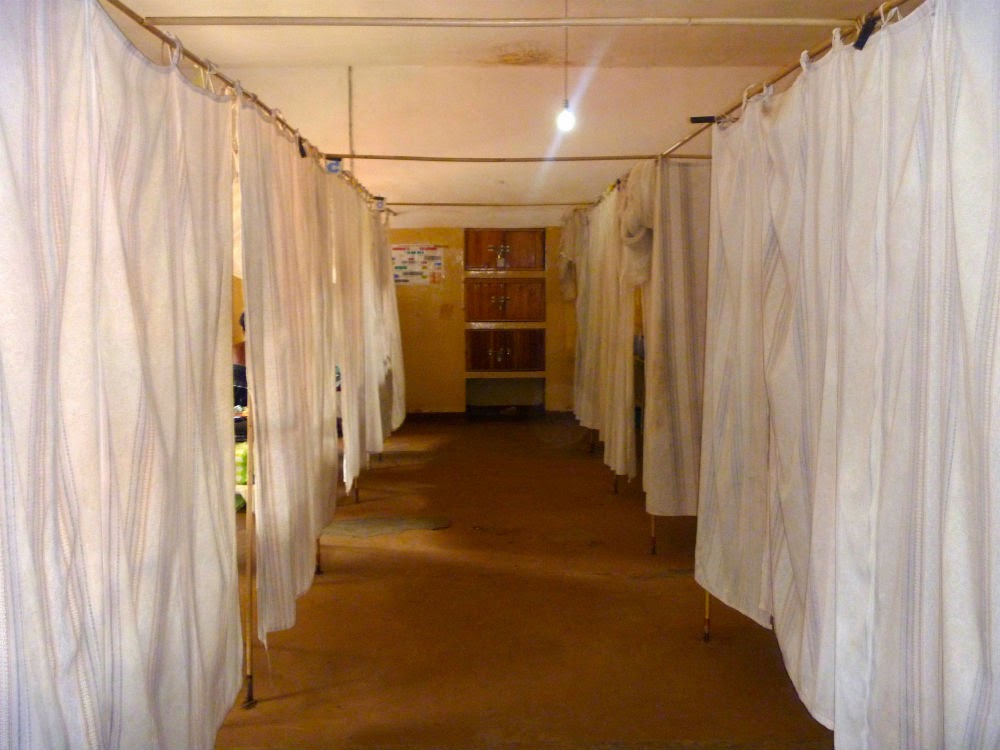
As the six of us Drake students toured Mukono Hospital with an administrator, it was apparent hospitals in the United States were much different from those in Uganda. In comparison to other hospitals in the surrounding area, Mukono Hospital’s sanitation and conditions are considered to be average. The various wards were separated into different sections throughout the hospital, but the wards were filled with openness with many beds separated only with a curtain that did not provide privacy. Despite this, many of the patients were happy to be receiving the care from these educated professionals along with the quality level of sanitation that was present.  Because of the high population in the area, it was unexpected to see there were empty beds throughout. I thought it was surprising to see how many services the hospital provided for the community: dental, oncology, maternity, radiology, and general care just to name a few.
One of the main goals of the hospital is to save lives and treat all of the patients who come regardless of their economic state. Because of this policy, patients receive the care needed and then pay upon discharge. If one is unable to pay for their treatment, they are let go without debt. This allows everyone to take advantage of the healthcare provided which enables a more sustainable community. It’s heartwarming that Mukono has valued saving lives over the cost of treatments.

With this idea of providing care to everyone, the challenge of funding is visible. Roughly 60% of their funding comes from patient payments. To meet the demands of some of the patients, the hospital is in the middle of building a second level onto a building which will provide private rooms at an additional cost.  In addition, many of their prescription drugs and equipment come from neighboring Joint Medical Stores and donations. Their HIV/AIDS drugs are administered through the government after receiving them from the CDC. To help with costs, the hospital does not provide food, water and bedding. This allows the hospital to allocate more of their funds to improving their sanitation and technology to provide more services for the community which will continue to improve the health of the community, leading to a more sustainable country.

Mukono Hospital

This afternoon, while the rest of the group visited the Luzira Prison, a group of six of us Drake students traveled to Mukono Hospital, a private Church of Uganda hospital, to visit with  administration and staff regarding the hospital's conditions and management. Despite the fact that our initial plans to meet with a Mukono Hospital doctor fell through, we were able to meet a hospital administrator, who answered our questions, and we were given a tour of the hospital and its facilities. While touring the hospital, it was interesting to see the various wards--for children, men, women, and pregnant mothers--have multiple beds separated from one another merely by curtains. Throughout the tour, we were able to communicate with other hospital staff, such as a laboratory technician and registered nurse. Mukono Hospital contained many hospital necessities, including a radiology room, dental office, operating room, ultrasound, and a laboratory for running tests (including HIV and malaria). According to the administrator, there are three doctors working in the hospital and one surgeon, seeing on average almost 80 patients and performing roughly five surgeries per day. It was an interesting experience seeing a hospital in Uganda that provided better care than I personally expected. The hospital was organized and clean, and the staff was knowledgeable and active. It was clear that providing healthcare to individuals was of utmost importance--particularly when the administrator said that they would care for patients even if the patient were unable to pay for the services. With hospitals like Mukono with a mission to provide quality healthcare to patients, a more sustainable healthcare system in Uganda can be possible if facilities and staff are improved to provide healthcare accessibility to all Ugandan citizens. 

Mukono Hospital.

The beds in the infant ward.

Beds in the maternity ward separated by curtains.

Operating room.

Wednesday, June 4, 2014

Sure Prospects

Located in between Kampala and Entebbe, Sure Prospects Institute is the only school in Uganda which integrates mental and physically disabled students and those without.  There are nearly 500 students attending this primary school with a 3:1 ratio of children without and those with a disability.  Francis, the headmaster and person who started this school, gave us a brief description when we arrived about how he started the program, emphasizing the importance of everyone being treated equally.  He gave the example that even though ones legs may not work, they can be very smart, and even though someone may have an intellectual disability that hinders their learning, their legs are perfectly fine for running! I loved this description and the fact that Francis is trying to change the mindset of the younger generation to be more accepting of those who are different from us.
Best Buddies is a nonprofit international organization that, with the help of volunteers, provides the opportunity for one-on-one friendships, employment opportunities and leadership development for those with intellectual and developmental disabilities. They have programs in middle and high schools as well as colleges with job and ambassador programs.  This entire school, in my eyes, can already be considered a chapter of Best Buddies.  Even though Sure Prospects is a school for those until they are a P6 or until they are 12 years old, Francis has started an additional program that allows those with disabilities to learn vocational training, computer skills, and other trade skills.  He is truly dedicated to the lives of these children in making sure they will be successful in their life and to meet whatever needs they may have.  Even though some of the children attending this school may not have the ability to graduate from a university for further education, with the help of this afternoon program for older children, they are able to invest their skills in a trade.
What Francis has done for these children, what he is dedicating his life towards, is quite amazing.  He is using Sure Prospects as a way to try and change the social sigma that those with special needs are not able to function in the world.  Starting with the children in kindergarten and putting this idea in their minds early will slowly help to change the views of everyone.  I loved spending the entire day with these children, playing games such as jump rope, chalk, bubbles, and Red Rover.  It was amazing to see what Francis has done and how his school has grown since he opened it.
For my fellow Drake students...how do you think Sure Prospects can evolve?  Should the current school system be changed from separating those with disabilities to integrating them like Francis' school?  How does government money play a role in schooling; should they integrate the schools even though that means spending more money?